The portrait series “Defying the Gaze Regime” (formerly Not Conceptual. Life) explores the concept of the “regime of the gaze” in the context of gender representations and portrays individuals who defy normative gender roles using a gender-specific visual language.
Art print edition
per motif 5 pieces, each in 2 sizes: 40x60cm and 80x120cm (plus each size 2 artist prints). Material: „Photo Lustre“ by Canson.
Find all suggested framings here.
 |  |  |
|---|---|---|
 |  |  |
 |  |  |
 |  |  |
 |  |
Catherine Lieser: » In my project “Defying the Gaze Regime”, I photographed people who defy normative gender roles by using gender-specific visual language.
In the context of visual media, a regime of the gaze refers to the fact that what we see is never reality itself, but always a constructed and structured representation of reality. Everything we consume in visual media is subject to an invisible order that determines “what” and “how” we see. A gaze regime defines what is considered “normal” and “correct” and, consequently, what is “worthless” or should not be visible at all. A gaze regime thus structures social norms and cultural conventions and stabilizes power relations.
This also applies to the portrayal of genders and gender roles.
The term was largely coined by the French philosopher Michel Foucault, who describes in his work “who is allowed to see whom, under what conditions, and how power is exercised as a result.” An early feminist analysis of the concept was conducted by the British film historian Laura Mulvey. She developed the idea of the “male gaze” and argued that Hollywood films, in particular, are structured from a male-heterosexual perspective and portray women as objects of desire..
Since we live in a patriarchal society, the regime of the gaze and patriarchy are closely intertwined. For this reason, it is necessary to briefly explain the structure of patriarchy here.
Patriarchy is a social system in which men hold dominant power in politics, the economy, and culture, and male values and norms predominate. Women, on the other hand, are structurally disadvantaged and are viewed as passive. As for non-binary people, only binary genders and heterosexual orientation are considered natural. Although these narratives were constructed by men and have evolved over time, they are presented as something “natural” and legitimize the exercise of power over women and other marginalized genders through sexism, violence, and social control.
Thus, the invisible order of the gaze regime is largely defined and maintained by cisgender heterosexual men.
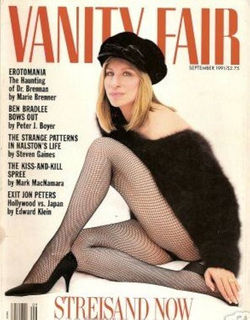
With my intend in mind, I researched photographs in which men are portrayed as dominant and women as passive objects of male desire and control.
I researched a total of four motifs that depict the same gender using the same visual language. For each motif I created a series, so that the visual language of the regime of the gaze becomes recognizable.
In order to visually contradict the patriarchal regime of gaze, I portrayed people who stand in contrast to the constructed gender narratives, using traditional visual language itself. «
Motif No. 1
A visual tradition of depicting men.


My photographical quote with queer Drag Queen Kelly Heelton.


Motif No. 2.
A visual tradition of depicting women.


My photographical quotes with interdisciplinary and queer artist Julakim and non-binary Play Temple host Gili Jala.


Motif No. 3
A visual tradition of depicting men.


My photographical quotes with queer drag queen Jazz Cortes.


Motif No. 4
A visual tradition of depicting women.


My photographical quotes with trans rapper Saphira, non-binary singer-songwriter Josephinex and queer author Nazli Karabiyikoglu.


Exhibtions
The series was exhibited, among many other places, at the European Month of Photography in Berlin 2023 within a grouph exhibition of the Berufsverband Freie Fotografen und Filmgestalter e. V. (BFF) and at the Kunstverein Familie Montez in Frankfurt am Main.
Four portraits are part of the Art Collection of the German Federal Ministry for the Environment.


